
A low-tech mark in my notebook keeps my signals from double-counting the same move.
Stop letting two signals tell you the same story
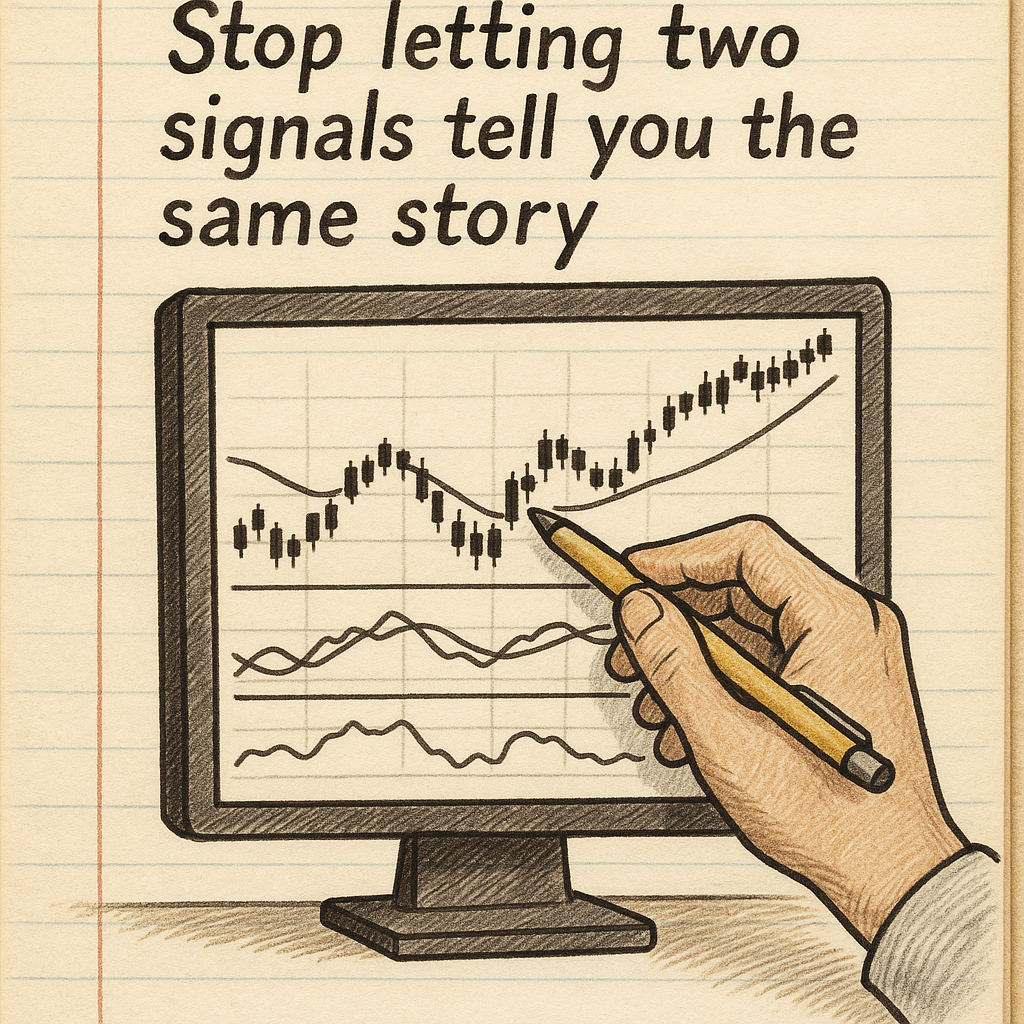
The fastest way I've found to ruin a strategy is to bolt indicators together because they look different on a chart. RSI + MACD + a moving-average crossover feels like diversification. In practice, you're often just counting the same underlying thing three times: price direction and recent range. When you wire that into an execution layer, it shows up as overconfident position sizing and a lot of "why did it flip twice in one morning?" trades.
When I'm integrating signals, I do one boring step before I touch weights: I classify each input by what it is allowed to know. Price-only, price+range, price+volume, price+order flow, and then fundamentals or event flags. You don't need a fancy taxonomy, you just need a rule that stops twins from sneaking in wearing different outfits. Classic pairs that pretend to be different: MA crossover and MACD (both trend), RSI and Stoch (both oscillator-ish), ATR and Bollinger band width (both volatility proxy). If you insist on keeping two from the same family, you have to justify what each adds when regimes change.
My litmus test is integration, not theory: if Signal B doesn't change your action when Signal A is already strong, it's dead weight. I log it as a shadow signal for two weeks (paper trades are fine), then check: how often did it veto a bad trade, and how often did it just shout "me too"? If you only remember the one heroic veto, you're being sentimental. The failures are quieter: you get chopped because your stack got louder at exactly the wrong time.
Weights that behave: start with a veto, not a blend
I used to do the classic thing: normalize every signal to a z-score, pick weights that felt reasonable, and call it integration. It backtested fine and then behaved like a weather vane in live trading. The problem wasn't the math, it was the decision surface. A blended score can drift across the threshold because one input gets noisy, even if the rest of your stack still says the market hasn't changed.
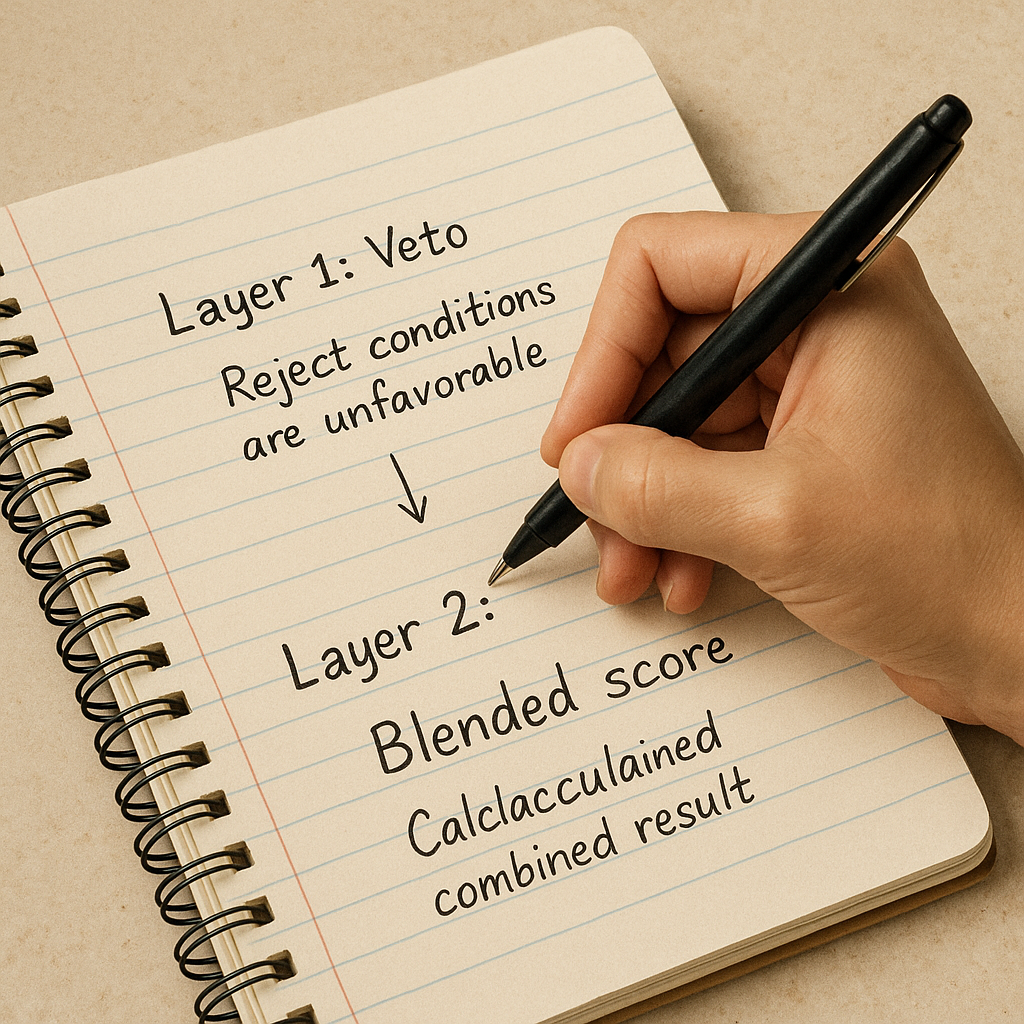
Now I build the integration in two layers. Layer one is a veto that answers one question: are conditions suitable for my edge to show up? For trend systems, the veto is usually volatility and liquidity related: if spreads widen, if realized vol spikes past my comfort band, or if I'm in a news window where my fill assumptions become fiction, I stand down. For mean reversion, it's often the opposite: if volatility collapses and everything is pinned, your "oversold" can stay oversold because nothing is moving.
Layer two is the blended score, but it's only allowed to speak when the veto says trading is permitted. That simple structure reduced my worst kind of trade, the one where a small shift in one input drags the whole composite into a position change. It also makes debugging humane. When something odd happens, I can answer: did we trade because the regime gate let us, or because the score really changed?
One concrete trick: I keep the weights coarse on purpose. If you find yourself tuning from 0.22 to 0.24, you're not integrating, you're optimizing a story. I round weights to the nearest 0.05, then run walk-forward. If performance only exists at a precise decimal, it won't survive a brokerage feed hiccup or a small change in market microstructure.
The notebook margin trick (and why it beats dashboards)
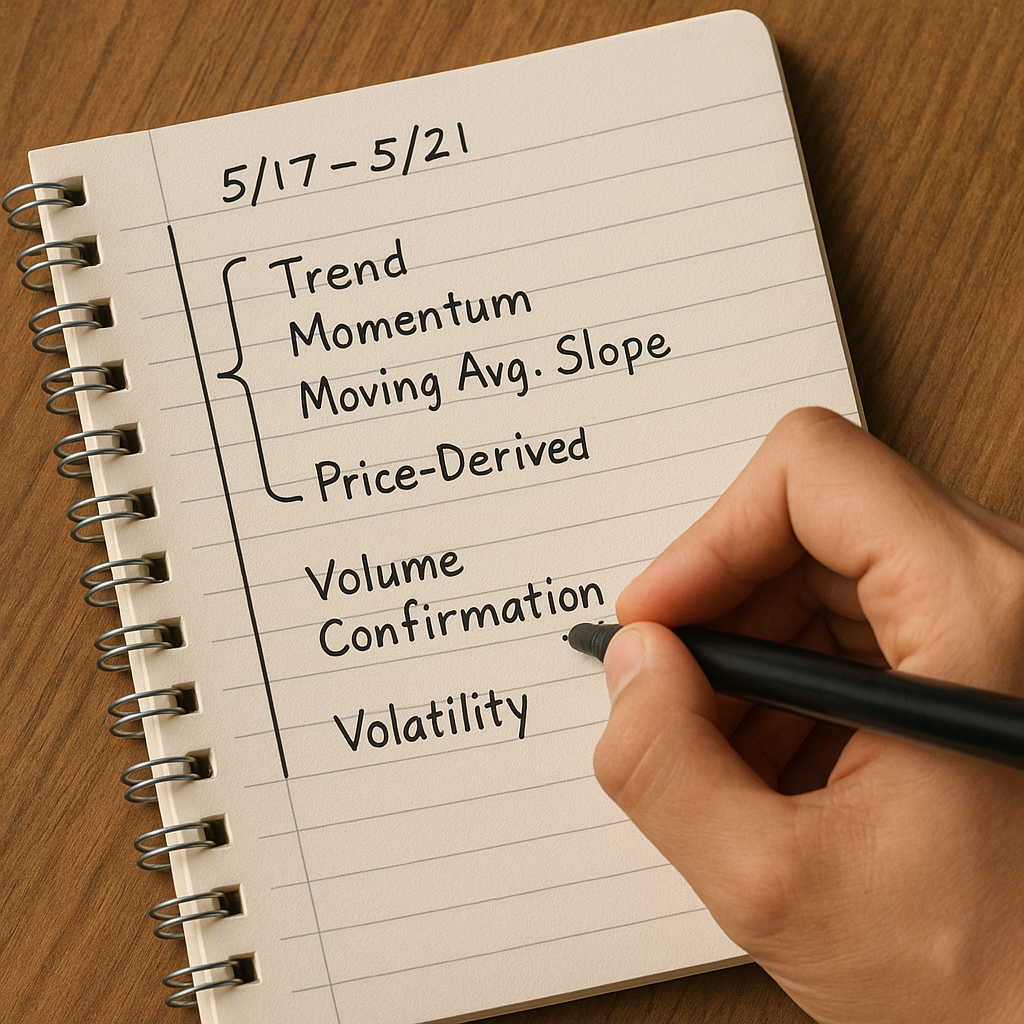
Here's the dumb, physical thing that fixed a recurring integration mistake for me: on a paper notebook page, I draw a skinny column down the left margin, like I'm back in high school. Every time I review a losing cluster of trades (not one trade, a cluster), I write the date range at the top and then I list the signals that were "responsible" for the entries and exits. The margin is reserved for one mark only: a little bracket that groups signals that are functionally the same input under different names.
Example. If my composite went long because trend, momentum, and a moving-average slope all flipped bullish within two bars, I bracket them together and label the bracket "price-derived." If volume confirmation also fired, it stays unbracketed. If my volatility filter allowed trading, I note it separately because it's a gate, not a vote. That margin bracket does something dashboards rarely do: it makes redundancy visually annoying. When I see three signals living inside one bracket, I can't pretend I'm diversified. I'm just louder.
Then I force myself to answer one question in a plain sentence: if I removed two of these bracketed signals, would I still have taken the trade? If the answer is yes, I don't touch weights first. I de-duplicate. Sometimes that means dropping an indicator. Sometimes it means changing sampling so two signals aren't both reacting to the same last 20 bars. Sometimes it means turning one into a veto (only trade when volume confirms) instead of letting it add to conviction.
The hands-on part is what surprised me: writing it out slowed me down enough to notice the pattern that was costing me money, which was flipping exposure because my composite was overfitted to one kind of movement. If you only do this inside a backtest notebook, it's too easy to rationalize. In ink, on one page, redundancy sticks out like a stain.