
Three early-stage valuation patterns I keep spotting in SAFE memos, option pools, and the first priced round math.
The SAFE that quietly sets your ceiling

I can't count how many times I've opened a draft SAFE and realized the valuation conversation already happened, just not out loud. Founders will tell me, "We haven't picked a number yet," and then I see (1) a cap, (2) a discount, and (3) an MFN clause that lets later investors pull the best terms backward. That combo is a pattern, and it matters because it creates a stealth ceiling for your next round. If you stack multiple capped SAFEs with different caps, your eventual priced round isn't negotiating from a blank page. It's negotiating against a pile of paper that will convert.
Here's the hands-on way I sanity-check it when I'm advising, using nothing fancier than a spreadsheet and the term sheet math you can do on a flight.
- Line up every SAFE by cap and discount. If you've got a $12M cap SAFE and later you take a $7M cap because you needed the check, you just told your next lead investor where the floor is, even if you never say it.
- Watch for the MFN "upgrade" effect. MFN isn't evil, but it can turn a later, tighter instrument into everyone else's better deal. I look for language that says investors can elect the most favorable terms in any subsequent SAFE. That's where the ceiling sneaks in.
- Run one conversion scenario. Pick a plausible priced round pre-money (say, the number you're hoping to pitch) and model the post-money ownership after conversion. If the result is, "Wait, why do we only own X%?" that's the moment you should have before you sign, not after.
What I see in early-stage valuation patterns is that founders tend to treat each SAFE as a standalone moment, but investors treat the stack as one instrument with a blended effective price. If you want negotiating room later, aim for consistency: fewer flavors of SAFE, a cap that doesn't whipsaw, and terms that don't boomerang across the stack. Your future lead will do this math in 10 minutes. You should, too.
Option pool math that makes a round feel smaller than it is
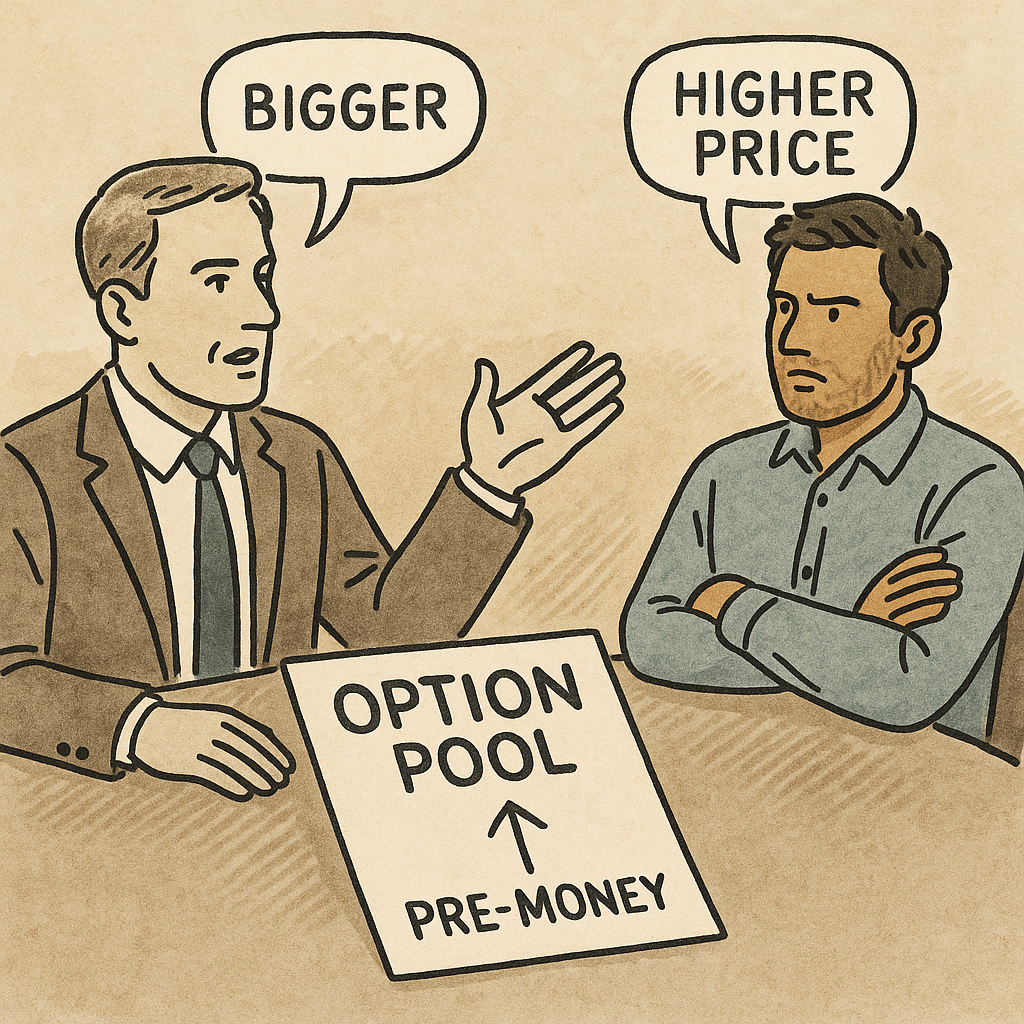
There's a specific moment in a priced round negotiation where everyone starts saying "standard" a lot, and it's usually around the option pool. Early-stage valuation patterns show up here because the pool is one of the cleanest levers to move founder ownership without changing the headline pre-money. I've sat in on enough of these to know the vibe: the investor wants a bigger pool "so you can hire," the founder wants a higher price "because momentum," and the compromise often lands on a pool increase that happens pre-money. That last part is the whole story.
Pre-money pool expansion effectively lowers the founders' percentage while letting the term sheet keep a pretty valuation number. It's not inherently bad. It just needs to be deliberate and tied to an actual hiring plan, not a shrug.
My practical check is boring on purpose. I ask for three roles and dates, then I translate that into pool math.
- Name the hires. Not "engineering". I mean: senior backend, founding AE, product designer. If you can't name them, you're not sizing a pool, you're negotiating in fog.
- Attach rough grant ranges. You don't need precision, but you should know if you're talking 0.25% or 2%. If your market comp assumptions are off, the pool request will be off.
- Decide what "unallocated" means. I like leaving a cushion, but not a mystery. If the pool increase is 10% and only 5% maps to hires, ask why you're pre-paying dilution.
Then I look at the term sheet language and confirm whether the pool is created before or after the financing. If it's pre, founders are the ones funding it. If it's post, everyone shares it pro rata. That's a real valuation lever, even though it's written like ops housekeeping.
When I see a round that "priced up" but founders ended up with basically the same ownership as last time, the option pool is usually the culprit. It's why I treat pool sizing as part of valuation, not a side conversation for the lawyers.
Post-money, pre-money, and why the first number you quote drifts

This is the early-stage valuation pattern that shows up in emails and then bites people in the data room: founders pitch a pre-money number, investors respond in post-money terms (especially if there are SAFEs converting), and by the time the term sheet lands, the original number has drifted even though nobody thinks they moved. It sounds like semantics until you calculate ownership.
I learned to force clarity with one sentence: "When you say $X, is that pre or post, and does it include the option pool and converting instruments?" If someone can't answer cleanly, the round isn't priced yet, it's just being described.
Three concrete places I watch the drift happen:
- SAFE conversion expectations. Founders think, "We'll raise a priced round at $15M pre." Investors think, "Cool, but the post-money after the SAFE stack is what matters." Both are rational, but the stack changes the effective price paid by new money.
- Pool inclusion. If your pool is being topped up pre-money, that affects founder ownership like a valuation change would. People forget to mention it in the same breath as the number.
- Round size creep. You start with "We're raising $3M" and two weeks later it's $4.5M because the demand is there (good problem). If you're quoting post-money, that changes the implied pre. If you're quoting pre-money, it changes dilution. Either way, the first number you told the market is now slightly untrue.
My fix is not philosophical. I keep a one-page "valuation definition" in the fundraising doc set that states, in plain English, the number you're using, what it includes, and what it excludes. It saves time when counsel starts redlining and it prevents the awkward moment where a lead says, "Wait, I thought this was post."
Early-stage rounds move fast, and people talk in shorthand. That's fine. But if you want control over the narrative, you have to pin the shorthand to an actual cap table outcome, not just a headline figure.